Vitamin B12 Deficiency: The Symptoms and Who Is at Risk
A doctor explains the symptoms of vitamin B12 deficiency, the blood levels that matter, who is most at risk, and why nerve damage can start before anemia.


The short version
- B12 deficiency causes fatigue, a sore smooth tongue, mouth ulcers, pins and needles, unsteadiness, and problems with memory and mood.
- Nerve damage can begin before any anemia appears, so a normal hemoglobin does not rule it out, and untreated nerve damage can become permanent.
- The highest-risk groups are people eating little or no animal food, those on long-term metformin or acid-suppressing medicines, people over 60, and anyone with stomach or bowel surgery or disease.
See a doctor promptly if
These are the signs that change this from something to read about into something to act on.
- Progressive numbness, unsteady walking, or difficulty with balance in the dark: spinal cord involvement needs urgent assessment
- New confusion, memory loss or personality change
- Breathlessness, chest pain or a heart rate that will not settle with severe anemia
Vitamin B12 deficiency typically shows up as unusual tiredness, a sore, smooth, beefy-red tongue, mouth ulcers, and pins and needles in the hands and feet, often with unsteadiness on the feet and difficulty concentrating. The critical point is that these nerve symptoms can appear before the blood count changes at all, so a normal hemoglobin does not rule the diagnosis out.
That matters because the neurological damage, if left long enough, does not fully reverse.
The symptom picture#
Blood-related: fatigue, breathlessness on exertion, palpitations, pallor with a faintly yellow tinge to the skin or eyes.
Mouth: a smooth, sore tongue with loss of the normal surface, recurrent mouth ulcers, altered taste.
Nerves: symmetrical pins and needles starting in the feet or hands, numbness, a sense of walking on cotton wool, worsening balance especially in the dark, and in advanced cases weakness.
Brain: poor concentration, memory problems, irritability, low mood. In older people this can be mistaken for early dementia, which is one reason B12 is checked in that assessment.
Who is at risk#
- People eating little or no animal food. B12 comes almost entirely from meat, fish, eggs, dairy and fortified foods.
- Long-term metformin use. It reduces B12 absorption over years, and periodic checking is reasonable to raise with your doctor.
- Long-term proton pump inhibitors or H2 blockers. Stomach acid is needed to release B12 from food.
- Pernicious anemia. An autoimmune loss of intrinsic factor, the carrier needed for absorption in the ileum. It often runs with thyroid disease and vitiligo.
- Stomach or bowel surgery, including bariatric surgery and ileal resection, and Crohn's disease or celiac disease.
- Age over 60, where reduced stomach acid production is common.
- Heavy alcohol use, and pregnancy in someone already borderline.
What the tests show#
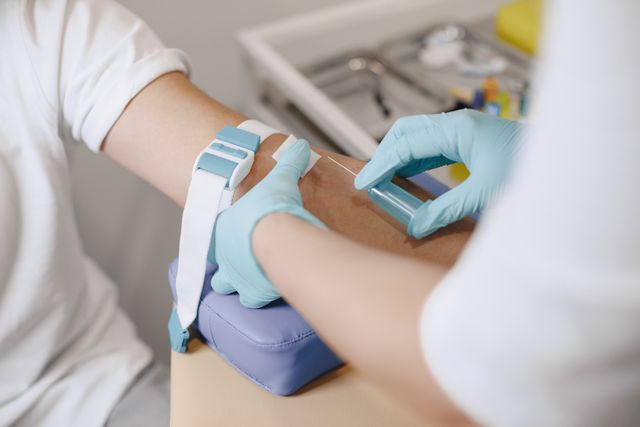
Serum B12 is the starting test. Below roughly 148 pmol/L (200 ng/L) is deficient; 148 to 258 pmol/L is a gray zone where methylmalonic acid or homocysteine helps decide.
On the full blood count, the classic finding is a raised mean cell volume: large red cells. But the MCV is normal in a substantial minority, and it can be misleadingly normal when iron deficiency coexists, since one raises cell size and the other lowers it. A normal MCV never excludes B12 deficiency.
If deficiency is confirmed without a dietary explanation, testing for anti-intrinsic factor antibodies looks for pernicious anemia, and celiac screening is often added.
Treatment, in outline#
Treatment depends on the cause. Absorption problems such as pernicious anemia have traditionally been treated with injections, while dietary deficiency usually responds to oral replacement, and high-dose oral treatment is increasingly used even in some absorption problems. Doses, forms and intervals differ by country and by cause, so this is a conversation for the doctor who has your results rather than something to self-manage.
Improvement in the blood count is usually visible within weeks. Nerve recovery is slower, sometimes taking months, and may be incomplete if treatment started late.
Where to take this next#
B12 and iron deficiency overlap constantly. Similar symptoms, frequently found together, and each capable of masking the other on a blood count. The full guide to iron deficiency anemia covers how that is diagnosed and corrected, and why the cause always matters more than the number.
Common questions
What blood level counts as deficient?
Can you have B12 deficiency without anemia?
Do vegetarians and vegans always need supplements?
Sources
Still not sure what this means for you?
Bring your reports to a call with one of our doctors. Leave with a written summary and the right questions for your own doctor.