What Does a High Prolactin Mean?
A doctor explains what a high prolactin means, why stress and medicines raise it more often than a pituitary tumor, and what the next tests usually are.

The short version
- Prolactin is the pituitary hormone that drives milk production, and a high level means the pituitary is releasing more than usual, which can interrupt periods, fertility and libido.
- Mild elevations are very often caused by stress, a difficult blood draw, nipple stimulation, medicines or an underactive thyroid rather than by a pituitary tumor.
- A level more than about three to four times the upper limit, or above 100 ng/mL (roughly 2,000 mIU/L), makes a pituitary adenoma much more likely and usually leads to an MRI.
See a doctor promptly if
These are the signs that change this from something to read about into something to act on.
- High prolactin with headaches or any change in peripheral vision, which needs prompt assessment
- Milky nipple discharge in someone who is not pregnant or breastfeeding
- Periods stopping for three months or more without pregnancy
Prolactin is the pituitary hormone that stimulates milk production, and it is normally low outside pregnancy and breastfeeding. A high prolactin means the pituitary is releasing more than usual, and because prolactin suppresses the hormones that drive the ovaries and testes, it can interrupt periods, fertility and libido. Most mildly high results are caused by stress, medicines or an underactive thyroid, not by a tumor.
Units differ by country, which causes a lot of confusion. Reference ranges are typically up to about 25 ng/mL in women and 20 ng/mL in men, equivalent to roughly 500 and 400 mIU/L.
Why the number is so easily disturbed#
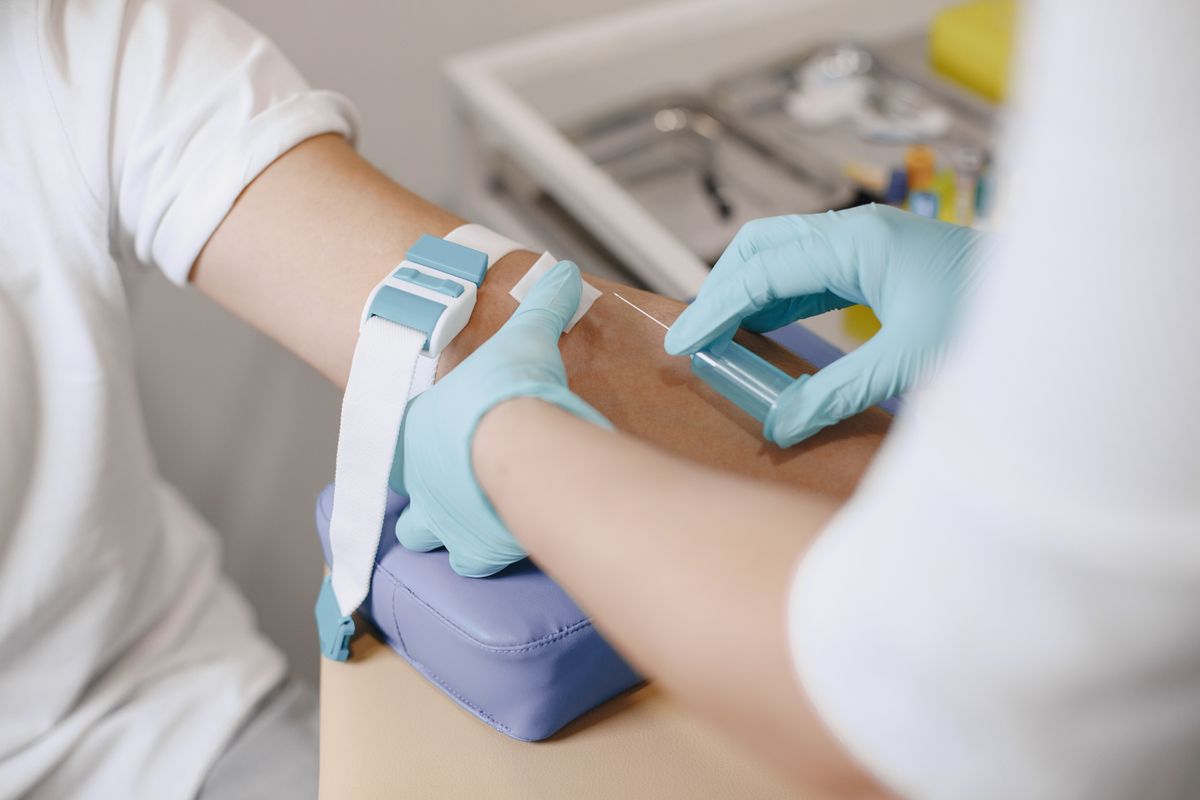
Prolactin is a stress responsive hormone. It rises with pain, exercise, sleep, sexual activity, nipple stimulation, a chest wall injury, and the anxiety of a needle. A rushed appointment after climbing stairs can produce a mildly high reading in a completely healthy person.
For this reason a repeat sample is standard practice: taken in the morning, rested for at least fifteen to thirty minutes beforehand, without exercise or breast stimulation that day. Many mildly high results normalize on that second test.
How high, and what it suggests#
| Prolactin | Usual implication |
|---|---|
| Just above the range to 50 ng/mL (about 1,000 mIU/L) | Stress, medicines, hypothyroidism, macroprolactin, PCOS |
| 50 to 100 ng/mL | Medicines or a small pituitary adenoma |
| Above 100 ng/mL (about 2,000 mIU/L) | A pituitary adenoma becomes much more likely |
| Above 250 ng/mL | Strongly suggests a prolactin secreting tumor |
Macroprolactin deserves a mention of its own. It is an inactive complex of prolactin and an antibody that the assay detects but the body cannot use, producing a high result in someone with no symptoms. Laboratories can test for it, and doing so avoids unnecessary imaging.
The causes worth checking first#
Pregnancy is checked first in anyone who could be pregnant, because it is the most common physiological cause by far. An underactive thyroid comes next, since a high TSH drives prolactin up and treating the thyroid corrects it. Then comes the medicine list, which is the largest avoidable group.
Chronic kidney disease raises prolactin too. Polycystic ovary syndrome is associated with mild elevations. Pituitary adenomas, usually small and benign, are the cause that imaging is designed to find, and they are far less common than the list above.
What happens next#
Expect a repeat prolactin under proper conditions, a pregnancy test where relevant, thyroid function, kidney function, and a macroprolactin check. If the level is confirmed high and unexplained, or is substantially raised, an MRI of the pituitary is the usual next step.
Treatment depends entirely on the cause and on whether symptoms exist. Small adenomas without symptoms are sometimes simply monitored. When treatment is needed it is usually effective, and it is prescribed and monitored by an endocrinologist.
Reading it with everything else#
Prolactin is rarely ordered alone. It usually arrives with thyroid, LH, FSH and sometimes testosterone or oestradiol, and the pattern across them is what gives the answer. The wider guide to understanding your blood test results explains how to approach a report like that.
Common questions
Can stress really raise prolactin?
What is macroprolactin?
Which medicines raise prolactin?
Sources
Still not sure what this means for you?
Bring your reports to a call with one of our doctors. Leave with a written summary and the right questions for your own doctor.